
Star Trek Outposts Unknown Resource Management Guide
Master Star Trek Outposts Unknown resource management with tips for production chains, crew shifts, storage, and planetary supply. Keep outposts running.
Jump to
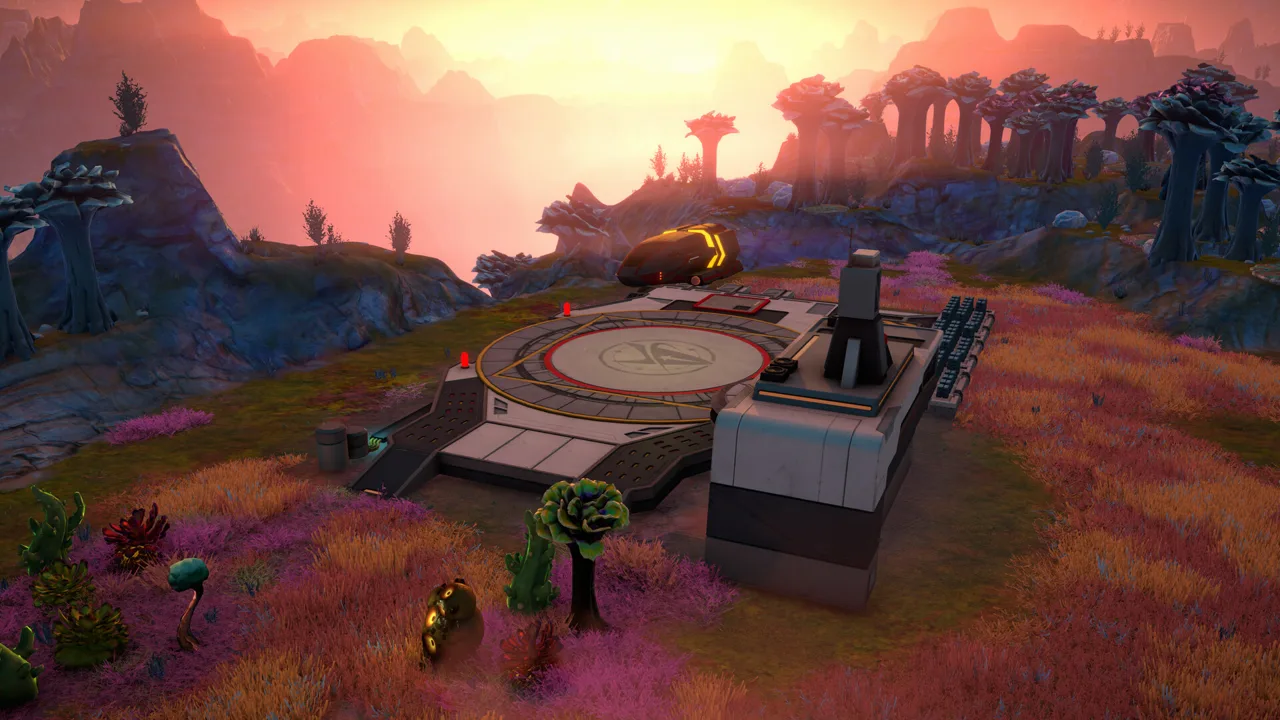
How Resource Management Works
A research outpost needs more than a pile of construction materials to survive. Star Trek Outposts Unknown resource management connects production, transportation, utilities, and crew support, so a shortage in one system can interrupt the work you actually need done. Start Star Trek Outposts Unknown resource management by tracing each stalled task back through its supplies, connections, and assigned personnel before expanding.
Your mission aboard the U.S.S. Resonant takes you across the X’Lehari System, establishing facilities to investigate the Tetryon Rift. Those facilities depend on 55 unique resources, alongside the water, power, and compute needed to keep buildings operating.
Materials pass through several stages: discovery, harvesting, refining, manufacturing, transportation, and use. Polyalloy, Duranium, Dutronic Chips, and Memory Banks belong to this wider resource economy. Learn each material’s role through its tooltip rather than assuming familiar Star Trek technology makes supplies unlimited.
| Resource or utility | Established dependency | What to check |
|---|---|---|
| Organic material | Food synthesizers require organic input | Access to biological resources |
| Food proteins | Surface mess halls use them to produce meals | Supplies supporting planetside crew |
| Deuterium | Fusion generators require it | Generator fuel availability |
| Water | Some advanced processes require it | Supply and infrastructure connections |
| Power and compute | Buildings require utilities to function | Each facility’s operating requirements |
Hover over resource icons to see where materials can be found or produced. Use that information to work backward from your current objective.
For example, when a construction project needs a manufactured material, inspect that material’s production requirements before assigning more harvesting work. The missing piece could be an intermediate product, a utility, or delivery to the construction site.
Keep your next decision specific: identify the missing input, find its production point, and check how it reaches its destination. Star Trek Outposts Unknown resource management becomes easier to follow when you solve a defined shortage instead of expanding every industry simultaneously.
Official page: Star Trek Outposts Unknown (playstack.com)
Keep Production, Storage, and Utilities Connected
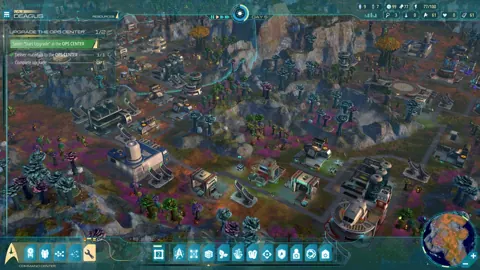
In Star Trek Outposts Unknown resource management, a completed building still needs the inputs and infrastructure required to operate. Account for those requirements while planning its location.
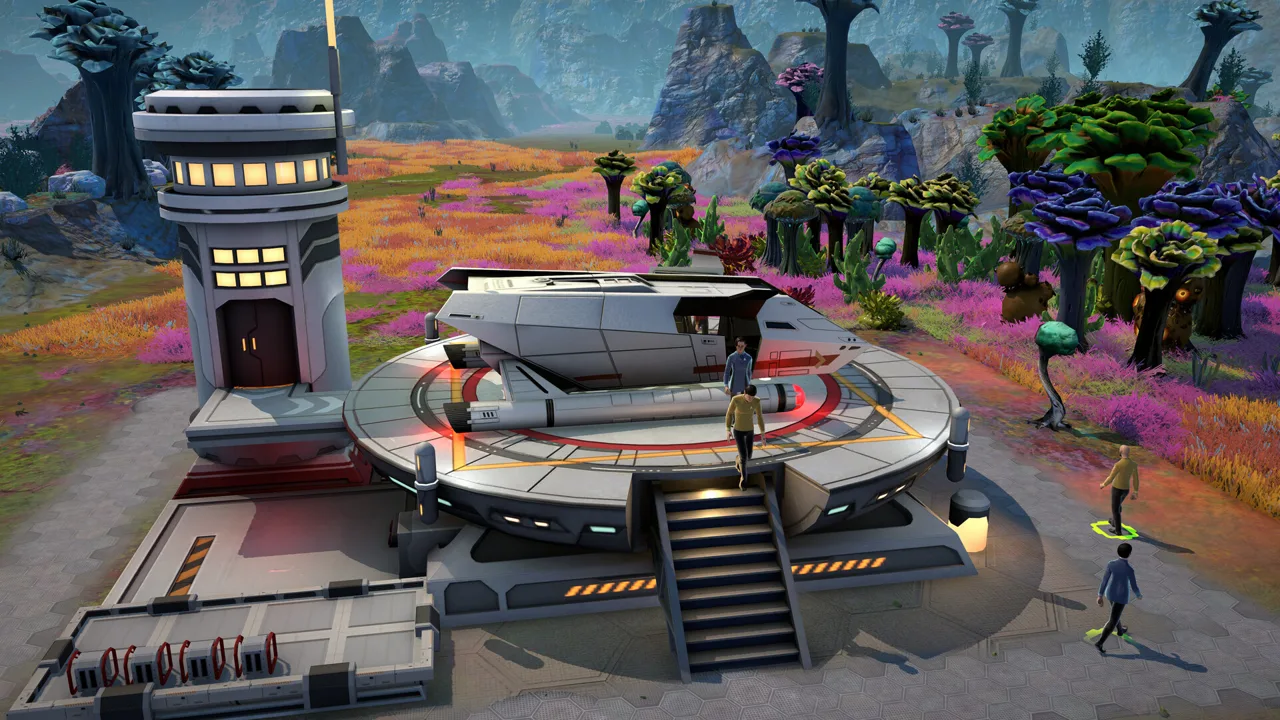 Image: Steam / Magic Fuel Games
Water pipes and utility conduits occupy physical space. Leave room for them around production areas, especially where several facilities will need connections. Network infrastructure is mostly free and instant to construct in the launch-era design, but it still needs a place in your layout.
Separate three questions whenever production stops:
- Does the required material exist?
- Can it reach the facility that needs it?
- Does that facility have its operating utilities?
These questions help you distinguish a harvesting shortage from a transportation or infrastructure problem. Building another collector addresses only one of those possibilities.
| Check | What to inspect | Action to take |
|---|---|---|
| Resource identity | The requested item’s tooltip | Locate its harvesting or production source |
| Production inputs | Materials needed by the facility | Supply the missing ingredients |
| Utility support | Water, power, and compute requirements | Check the relevant connections and supply |
| Storage | Space for incoming supplies and output | Review storage organization before adding deliveries |
| Transportation | Movement between collection, storage, and use | Inspect the route and available transport |
Storage deserves attention before a resupply arrives. The Resonant carries useful materials, while your outposts need room to receive and use them. Review storage organization alongside construction plans rather than waiting until several deliveries compete for space.
Ground and air vehicles support exploration and faster resource movement between facilities. Consider transportation needs as your footprint spreads across the landscape. A distant extraction site adds a delivery problem even when it provides exactly the material your outpost needs.
Keep related stages of production near one another where terrain, utilities, and shielding allow. Leave access for transportation and future connections. Judge a layout by whether materials can move through it reliably.
Before committing to another production building, inspect the one already serving that job. Restore a missing connection or input before spending construction resources on additional capacity.
Match Crew Assignments to the Supply Chain
Crew support belongs at the center of Star Trek Outposts Unknown resource management. Additional personnel bring useful skills, but they also need the facilities and supplies that sustain life on the surface.
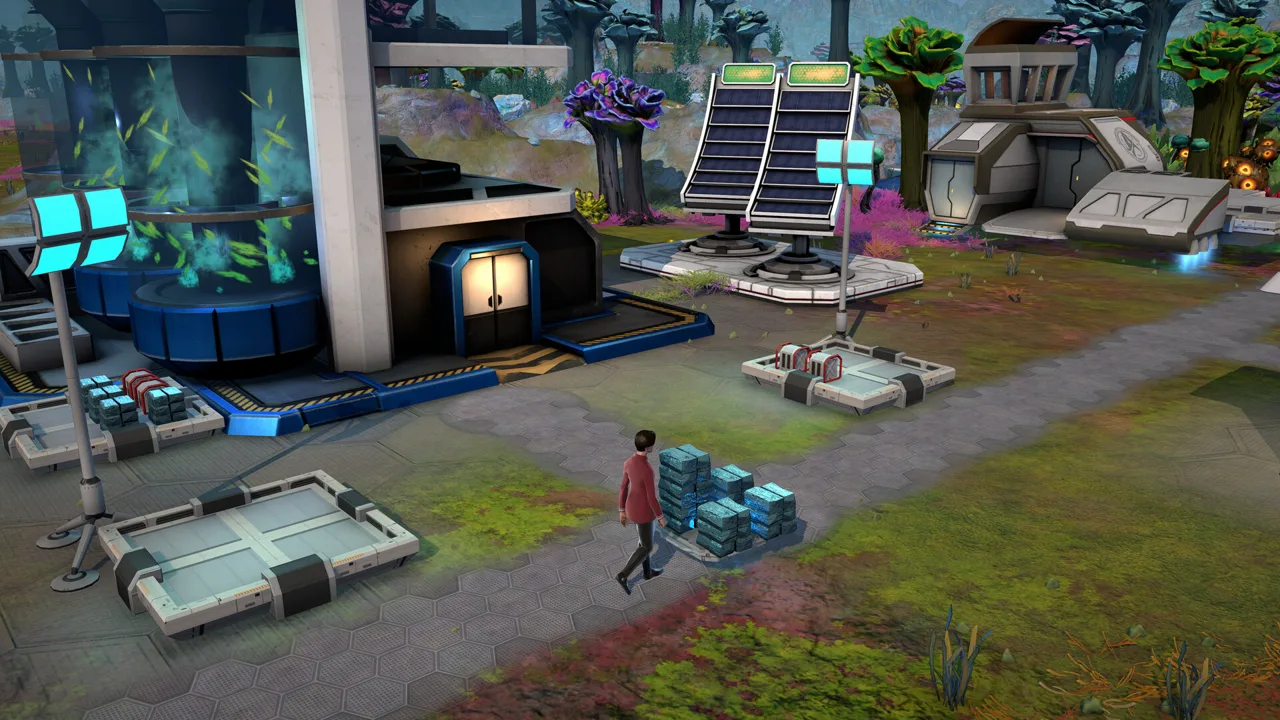 Image: Steam / Magic Fuel Games
Your officers cover Command, Engineering, Medical, Navigation, Science, and Security. Examine individual competencies when new crew arrive, then assign responsibilities around the work your outpost currently needs.
| Crew role or system | Relevant function | Practical instruction |
|---|---|---|
| Science officers | Investigate unfamiliar materials and formations | Assign scientific investigation where new resources need examination |
| Engineers | Maintain buildings through direct commands | Respond to damaged facilities without waiting for the regular queue |
| Medical officers | Treat injured crew through direct commands | Address injuries while longer production jobs continue |
| Security personnel | Respond to threats | Keep threat response available during exploration |
| Day and night shifts | Let you choose who works each period | Review staffing across both shifts |
| Surface support facilities | Provide housing, meals, medical care, and entertainment | Supply these facilities before relying on an independent outpost |
Direct crew commands bypass the normal work queue. Use them when an emergency needs immediate attention while construction and production goals remain scheduled.
That distinction matters during a crisis. A repair or medical response should receive deliberate attention instead of disappearing among routine assignments. Select the appropriate officer and address the immediate problem, then return to the broader supply chain.
Organize day and night shifts around both production and support. Review which personnel are available during each period, and include the people needed to maintain facilities and respond to danger. Some points of interest appear only at night, giving exploration its own scheduling demands.
Before bringing more crew into your operation, check the resources needed to support them. Housing, food, and medical facilities form part of expansion planning.
Build toward a surface settlement that can function while the Resonant travels elsewhere. Crew quarters, mess halls, medical facilities, and entertainment options support that independence. Inspect their supplies alongside your industrial buildings; scientific work still depends on a crew with somewhere to eat, recover, and live.
Plan Supplies Around Each Planet
Star Trek Outposts Unknown resource management extends across multiple worlds. Each destination has different environments, and resources do not appear evenly across those environments.
 Image: Steam / Magic Fuel Games
Daegus includes a temperate oasis, rocky desert, and crystalline landscapes. Kourou combines glaciers, volcanic badlands, and steam fields. Neral is the final planet you explore and presents the expedition’s most hostile environment.
| Planet | Environmental features | Supply consideration |
|---|---|---|
| Daegus | Temperate oasis, rocky desert, and crystalline formations | Explore its different environments for their distinct resources |
| Kourou | Glaciers, volcanic badlands, and steam fields | Plan organic supply around the steam fields |
| Neral | Three biomes and especially hostile conditions | Include environmental protection in expansion decisions |
Kourou makes the connection between geography and supply especially clear. Its steam fields contain the planet’s only source of organic material, while glaciers conceal important resources beneath their surface.
Inspect a new world’s resource distribution before stretching your outpost toward a distant deposit. Include the route, environmental danger, required facilities, and supporting utilities in the decision.
Resource transfers between planets let you cover local shortages. Use that capability when an established location can supply something another outpost needs. Check the sending outpost’s own requirements before committing its materials elsewhere.
The Resonant supports planetary operations until an outpost becomes self-sufficient. Before departure, inspect housing, medical facilities, meal production, storage, and the utilities supporting those systems.
The mess hall offers a practical example: its food proteins must be available for meal production. Inspect the ship’s inventory and send needed proteins to the surface before leaving the settlement to operate independently.
Periodic passing ships also deliver personnel and key resources. Review those arrivals against your existing needs. New supplies can help an expansion, while new officers increase the support your operation must provide.
Keep interplanetary logistics tied to a clear purpose: supplying a local shortage, establishing a new outpost, or sustaining research after the Resonant moves on.
Budget for Shielding and Renewable Harvesting
Protection is part of Star Trek Outposts Unknown resource management because the Tetryon Rift threatens both personnel and infrastructure. More structures require special shielding as your operation develops.
Shield Emitters are expensive expansions that depend on processing rare materials. Choose the areas you want to protect before committing to a larger footprint.
Compare an expansion’s intended resource or research objective with the facilities needed to support it. Include shielding, transportation, utilities, and crew care in that assessment. A deposit’s value has to be considered alongside the work required to reach and use it.
Keep essential operations within appropriate protection, and review coverage as the settlement grows. Position new facilities with the shielded area in mind rather than treating protection as a separate project after construction.
When dangerous conditions disrupt work, use engineers and medical officers to address damage and injuries. Keep those responses connected to your recovery priorities: restore the facilities and personnel your immediate objectives depend on.
Biological harvesting brings another responsibility. Harvested specimens contain seeds that can be replanted and regrown, allowing you to restore what your outpost collects.
Replant biological resources as you harvest them. Include ecological restoration in your regular resource routine, especially where organic supplies support continued operations.
Before your next expansion, run through this checklist:
- Inspect the materials required for the planned construction.
- Check the production chain supplying those materials.
- Review storage and transportation.
- Account for water, power, and compute.
- Check crew support and shielding.
- Replant harvested biological specimens.
Use this checklist to keep Star Trek Outposts Unknown resource management focused on a complete operating outpost. Give each new facility the supplies, connections, protection, and personnel it needs to contribute to the mission.
FAQ
How many resources are in Star Trek: Outposts Unknown?
The launch-era game includes 55 unique resources. These materials support harvesting, refining, manufacturing, construction, and scientific work. Buildings also require utilities such as water, power, and compute.
What should I check first in Star Trek Outposts Unknown resource management?
Inspect the resource or facility involved in the stalled task. Read its requirements, check the relevant material supply, and examine storage, delivery, and utility connections. Address the missing dependency before adding more production buildings.
Can an outpost operate while the U.S.S. Resonant is elsewhere?
Yes. Outposts can become self-sufficient through surface housing, mess halls, medical facilities, and other supporting systems. Supply those facilities before departure, including the food proteins needed for mess hall production.
How do I maintain organic supplies on Kourou?
Plan around Kourou’s steam fields, the planet’s only source of organic material. Use interplanetary resource transfers to cover local shortages, and replant the seeds contained in harvested biological specimens.
Continue with
 Star Trek: Outposts Unknown Food Guide: Feed Your CrewMaster Star Trek Outposts Unknown food with tips on food proteins, mess halls, cargo transfers, and organic supplies. Keep your crew fed on alien worlds.
More in Resources
See all ResourcesQuick access

Star Trek Outposts Unknown Release Date: Out Now on PC
Star Trek Outposts Unknown release date was October 20, 2026. Explore PC launch details, the $32.99 price, Mac plans, and tips for your first outpost.

Star Trek Outposts Unknown Demo Removed: What Happened?
Star Trek Outposts Unknown demo removed? Learn why the trial ended, what changed before launch, and how to play the full Steam release on Windows PC today.
Star Trek Outposts Unknown Guide: Build and Survive
Use this Star Trek Outposts Unknown guide to manage crew, fix resource bottlenecks, protect your outposts, and prepare for planets in the X’Lehari System.
Star Trek Outposts Unknown Building Tree Explained
Use the Star Trek Outposts Unknown building tree, plan resource chains, manage power and shielding, and prepare your outposts for life without the ship.
Join the community
Official channels for news, updates and player help: