
Star Trek Outposts Unknown Guide: Build and Survive
Use this Star Trek Outposts Unknown guide to manage crew, fix resource bottlenecks, protect your outposts, and prepare for planets in the X’Lehari System.
Jump to
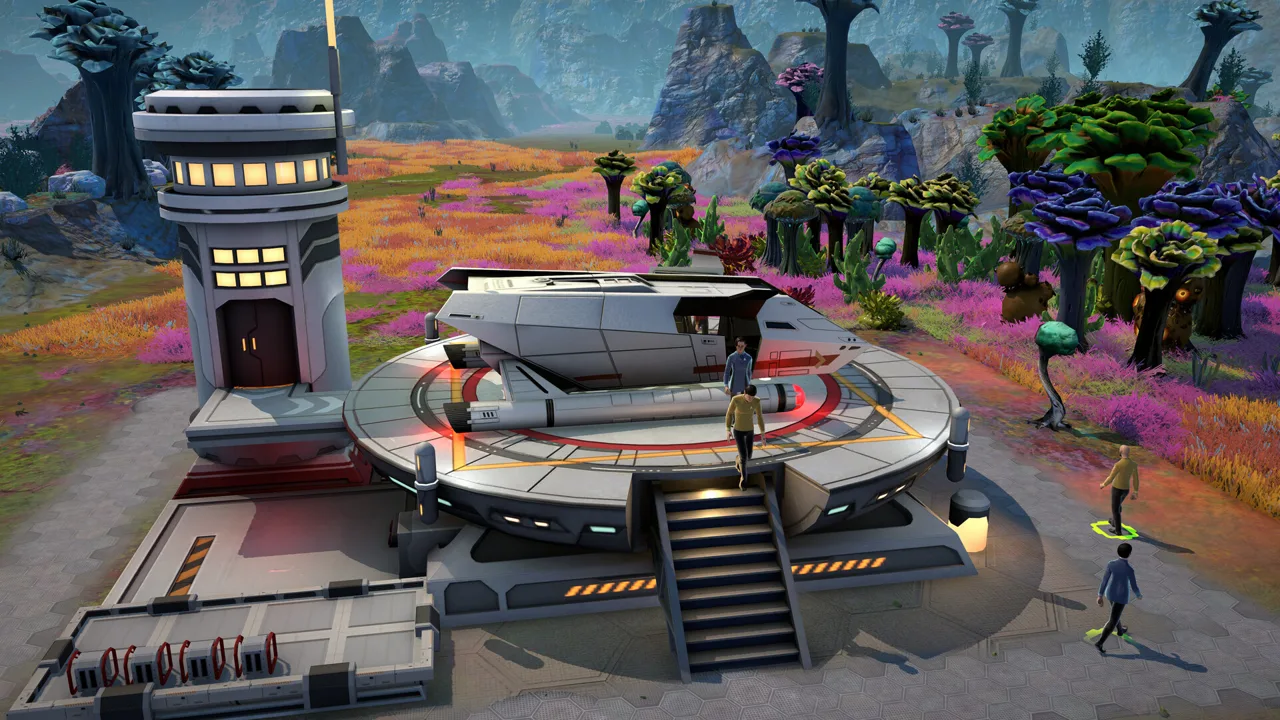
How to Build an Outpost That Can Survive Without Your Ship
Your next scientific breakthrough depends on keeping your outpost running, and this Star Trek Outposts Unknown guide starts with the systems that make that possible. Food, power, crew health, and material deliveries keep research moving while the Tetryon Rift threatens your expedition. Use this Star Trek Outposts Unknown guide to organize those dependencies before spreading your crew across the X’Lehari System.
You command the U.S.S. Resonant in a narrative-driven outpost builder set in the 23rd century, during the era of Star Trek: Strange New Worlds. Your mission combines scientific investigation, planetary construction, and support for a civilization facing catastrophe.
Build toward self-sufficiency before sending the Resonant elsewhere. Your ship supports developing outposts, but surface operations need housing, food, medical facilities, and reliable supplies to continue independently.
Work through these priorities as your mission introduces them:
- Read the current objective. Identify the research, construction, or exploration task you need to support.
- Inspect its dependencies. Check materials, crew assignments, utilities, and transport.
- Support the crew doing the work. Account for meals, accommodations, health, and shifts.
- Prepare for environmental danger. Plan protection alongside expansion.
- Check the outpost before departing. Make sure essential facilities have the inputs they need.
Avoid treating every newly available structure as an immediate construction goal. Follow the dependency that is blocking your current objective, then expand around a functioning operation.
Keep Resources Moving Through the Entire Production Chain
Resource management connects nearly everything in this Star Trek Outposts Unknown guide. At launch, the game includes 55 resource types, with materials passing through research, harvesting, refining, manufacturing, and transportation before reaching their final use.
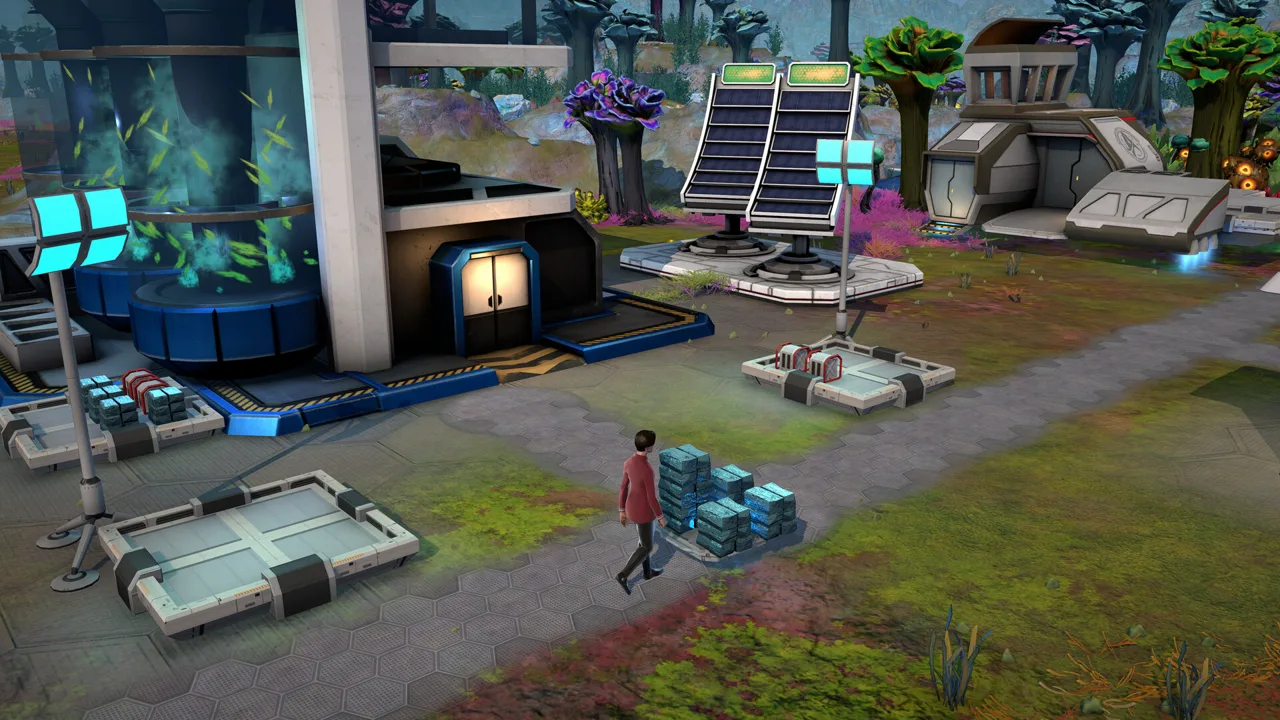 Image: Steam / Magic Fuel Games
A stockpile alone does not keep a facility working. Buildings also need their required utilities and production inputs.
| System | What it supports | What to check |
|---|---|---|
| Water | Building upkeep and certain advanced processes | Supply and required pipe connections |
| Power | Facility operation | Generation, connections, and demand |
| Compute | Buildings that require processing capacity | Available capacity and network access |
| Storage | Incoming materials and production logistics | Room for deliveries and organization |
| Material inputs | Manufacturing and scientific work | Required ingredients and their delivery |
Trace shortages backward
When production stalls, inspect the affected building before ordering more construction. Read its requirements, identify the missing input, and follow that material back through its production chain.
Hover over resource tooltips to see where materials can be found or produced. Use the logistics filters and management screens to track what your outpost needs.
For example, food synthesizers require organic input, fusion generators consume deuterium, and some advanced processes require water. Check those dependencies before relying on the output.
Keep these distinctions in mind:
- Available somewhere: The resource exists within your operation.
- Delivered where needed: The consuming facility has received its input.
- Sustainable supply: Collection, production, and transport can continue supporting demand.
Use those questions to diagnose a shortage instead of repeatedly expanding the same production stage.
Leave room for infrastructure
Pipes and conduits occupy space. Reserve routes for utilities when placing production buildings, particularly around facilities you expect to expand.
Network infrastructure became mostly free and instant to build ahead of launch, but connections still deserve attention. Inspect the actual route between supply and consumer rather than assuming nearby buildings are connected.
Organize storage around the materials your active projects consume. Before accepting another delivery or expanding manufacturing, check whether you have room for the incoming goods.
Replant biological resources
Harvested biological specimens contain seeds that can be replanted and regrown. Include replanting in your resource routine rather than treating organic collection as a one-way process.
When reviewing a biological supply chain, check both the immediate harvest and the regrowth supporting future collection. Keep scientific progress and the local environment in the same plan.
Assign Crew by Role and Support Their Shifts
Your crew is more than a construction workforce. Officers have different competencies, dangerous encounters test their capabilities, and your leadership affects their dedication to the mission.
 Image: Steam / Magic Fuel Games
The crew-management priority in this Star Trek Outposts Unknown guide is straightforward: match the assignment to the officer, then support that officer on the surface.
| Crew role | Available action | Assignment tip |
|---|---|---|
| Engineering | Maintain buildings through direct commands | Address damaged infrastructure alongside construction |
| Medical | Treat injured crew through direct commands | Respond to injuries while other work continues |
| Security | Respond to threats through direct commands | Keep threat response in mind when exploring |
| Science | Investigate planetary materials | Use scientific investigation to understand local resources |
Direct field commands bypass the normal work queue. Use them when an emergency needs attention while longer construction and production plans remain queued.
An injured officer does not need to wait behind your entire building agenda before receiving a medic’s attention. Likewise, direct an engineer toward maintenance when damage threatens essential operations.
Recruit for both capability and capacity
Periodic resupply ships bring additional personnel and key resources. Examine each incoming officer’s competencies and consider the support required for more crew.
Before expanding your workforce, check:
- Available accommodations.
- Food production and its inputs.
- Medical support.
- The roles needed for current assignments.
More personnel also means more people to house and feed. Expand the support systems alongside recruitment.
Use day and night shifts deliberately
You can assign crew to day or night work. Review those assignments alongside the work you need completed and the facilities supporting your surface population.
Some points of interest appear only at night, giving nighttime exploration its own purpose. Include the night cycle when checking a planet for discoveries.
Crew quarters, mess halls, medical facilities, and entertainment options help outposts become self-sustaining. Build these services into your departure preparations so the Resonant can travel while ground research continues.
Monitor crew happiness, health, danger, and sense of purpose. Use those conditions to guide your next assignment or support project.
Protect Your Expansion From Radiation and Local Threats
The Tetryon Rift affects both planetary safety and transportation. Radiation threatens crew and structures, while interference limits your ability to rely on transporters across planetary surfaces.
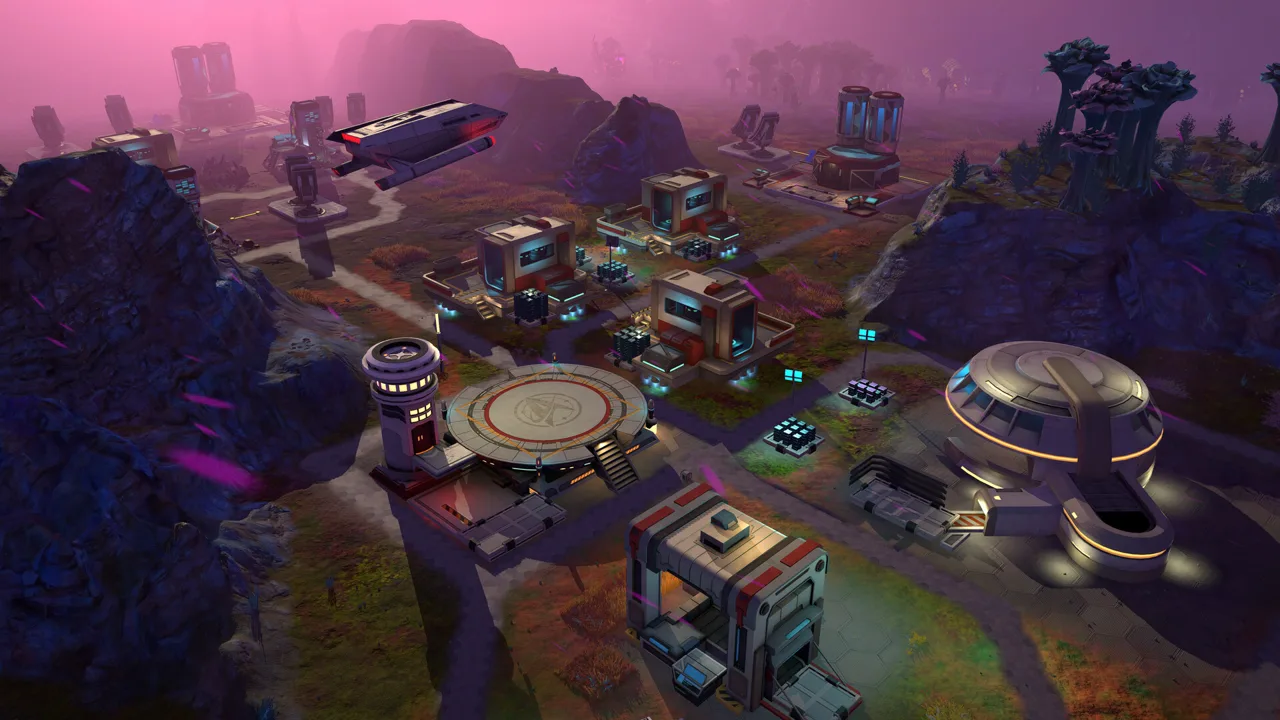 Image: Steam / Magic Fuel Games
Protection belongs in your expansion plan. Shield Emitters are costly structures that require processed rare materials, so choose the areas you intend to protect before committing resources.
| Hazard or constraint | Effect on operations | Preparation |
|---|---|---|
| Tetryon radiation | Threatens crew and requires protection for structures | Plan Shield Emitter coverage around expansion |
| Transporter interference | Restricts planetary transport options | Establish landing pads for crew travel |
| Injuries | Create a need for medical care | Provide treatment facilities and use medic commands |
| Large planetary distances | Extend travel and resource movement | Incorporate available ground and air vehicles |
Plan around shield coverage
Treat shield coverage as a boundary when laying out your outpost. Review the area you want to protect, the materials required, and the facilities that would depend on that protection.
Keep expansion focused. Before extending into another area, ask which mission task or resource need justifies the additional protected space.
This Star Trek Outposts Unknown guide emphasizes protection because an outpost must support both its buildings and the crew operating them. Pair new production capacity with the infrastructure needed to keep it functioning.
Keep transportation ready
Landing pads let crew travel back to the Resonant when transporter interference complicates movement. Include that connection when establishing a new planetary foothold.
Ground and air vehicles support exploration and faster resource transfer between facilities. Review travel distances when arranging distant collection and production work, then use available vehicles to support those routes.
When threats appear, use role-specific direct commands. Keep medical treatment, security response, and engineering maintenance available alongside your longer work queue.
Prepare for Kourou and a Network of Planetary Outposts
Each planet changes the resources and hazards you need to manage. Use this Star Trek Outposts Unknown guide as a preparation checklist when moving from one environment to another.
| Planet | Environments | Planning focus |
|---|---|---|
| Daegus | Temperate oasis, rocky desert, and crystal formations | Explore beyond the lush terrain |
| Kourou | Moving glaciers, volcanic badlands, and steam fields | Prepare for extreme cold and localized resources |
| Neral | Three biomes in the game’s most hostile planetary environment | Review protection and logistics before expanding |
Finish the departure check
Before leaving an established outpost, inspect its medical facilities, mess halls, housing, storage, and utility supplies.
Pay particular attention to food inputs. A surface mess hall requires food proteins to produce meals. Transfer supplies from the Resonant when necessary, then review whether the outpost can continue supporting its crew.
Use this departure checklist:
- Housing is available for the surface crew.
- Food facilities have the ingredients they consume.
- Medical facilities are supplied.
- Production buildings have water, energy, compute, and material inputs where required.
- Storage can accommodate supplies.
- Resource transfers cover local shortages.
Interplanetary resource transfers let you fill gaps between worlds. Plan those transfers around actual shortfalls rather than expecting every location to supply everything locally.
Establish your Kourou foothold
Choose experienced officers whose competencies fit the work ahead. On arrival, establish headquarters and basic facilities that protect your crew from extreme cold.
Set up landing pads so personnel can return to the Resonant. Assign a science officer to investigate local materials and identify resources for the developing outpost.
Kourou’s steam fields contain the planet’s only source of organic material. Moving glaciers conceal important resources, while volcanic terrain brings fire and magma hazards. Account for those differences when deciding where to investigate and expand.
Complete faction requests with supply needs in mind
Visiting factions offer resource missions. Fulfilling requests increases Starfleet’s recognition in the sector and opens further ways to investigate the region’s mysteries.
Check requested goods against your operating needs before sending them away. Keep the inputs needed for meals, essential production, and ongoing research in view.
For this Star Trek Outposts Unknown guide, the central habit is to review the whole network: your ship, surface crew, research facilities, and resource transfers all support the same mission.
FAQ
What should I prioritize in a Star Trek Outposts Unknown guide?
Prioritize functioning supply chains, crew support, and protection. Inspect the materials and utilities behind your current objective, then prepare housing, food, and medical services before leaving an outpost without the Resonant.
Is Star Trek: Outposts Unknown available on Mac?
The game is available on Windows PC through Star Trek: Outposts Unknown on Steam. Mac support is planned for a future patch. The Windows release launched on October 20, 2026.
Can outposts operate while the Resonant explores elsewhere?
Yes. Self-sustaining surface facilities allow research to continue while the ship travels. Prepare housing, meals, medical support, utilities, and necessary supplies before departure.
How do I respond to emergencies without interrupting the work queue?
Select an appropriate crew member and use their direct field action. Engineers can maintain buildings, medics can treat injuries, and security officers can respond to threats. These commands bypass the normal work queue.
Continue with
 Star Trek Outposts Unknown Multiplayer: Co-Op GuideStar Trek Outposts Unknown multiplayer explained: learn how solo crew management works, what Steam features mean, and how to prepare research outposts.
More in Guide
See all GuideQuick access

Star Trek Outposts Unknown Release Date: Out Now on PC
Star Trek Outposts Unknown release date was October 20, 2026. Explore PC launch details, the $32.99 price, Mac plans, and tips for your first outpost.
Star Trek Outposts Unknown Demo Removed: What Happened?
Star Trek Outposts Unknown demo removed? Learn why the trial ended, what changed before launch, and how to play the full Steam release on Windows PC today.
Star Trek Outposts Unknown Building Tree Explained
Use the Star Trek Outposts Unknown building tree, plan resource chains, manage power and shielding, and prepare your outposts for life without the ship.

Star Trek: Outposts Unknown Food Guide: Feed Your Crew
Master Star Trek Outposts Unknown food with tips on food proteins, mess halls, cargo transfers, and organic supplies. Keep your crew fed on alien worlds.
Join the community
Official channels for news, updates and player help: