
Star Trek Outposts Unknown Steam: Launch & Crew Guide
Explore Star Trek Outposts Unknown Steam launch details, PC requirements, crew management, and outpost logistics. Plan your mission across alien worlds.
Jump to
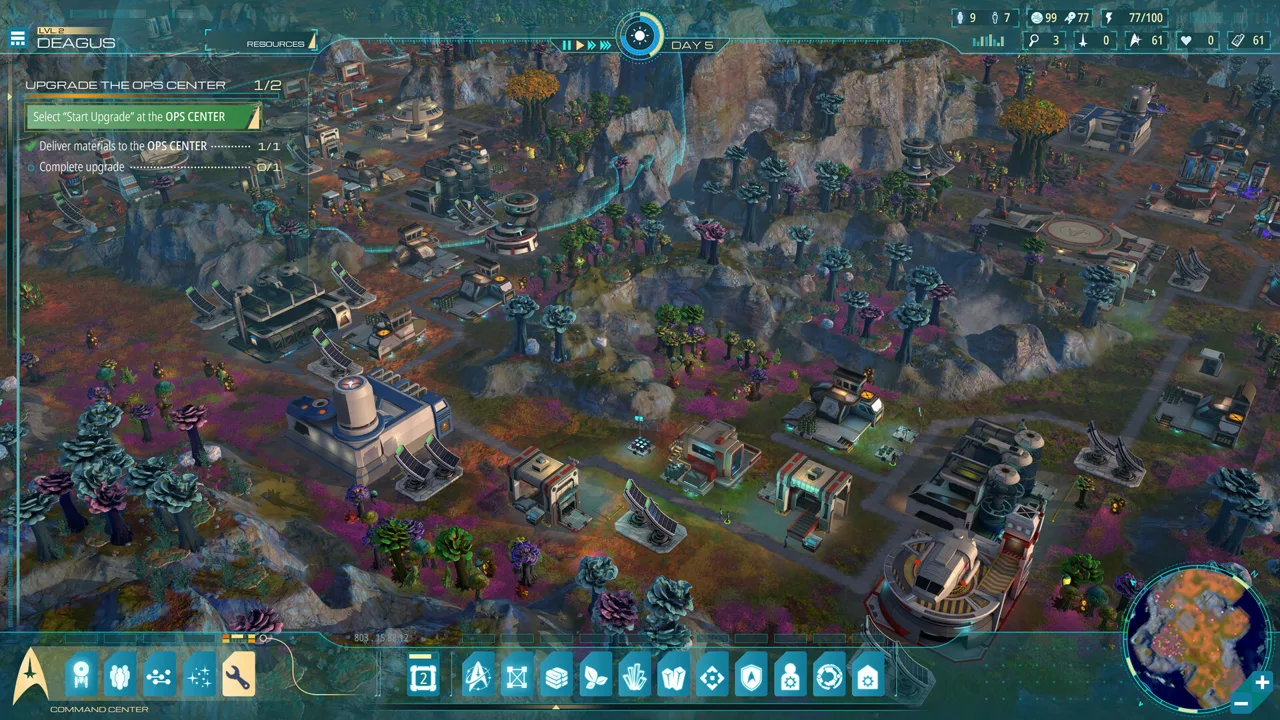
Is Star Trek: Outposts Unknown Available on Steam?
Your Star Trek Outposts Unknown Steam adventure begins with a practical challenge: keep a research outpost running when your starship leaves orbit. The game launched for Windows PC on October 20, 2026, putting you in charge of scientific exploration, production chains, and the people holding everything together. This Star Trek Outposts Unknown Steam guide covers the launch essentials, hardware requirements, and management decisions to understand before taking the captain’s chair.
Developed by Magic Fuel Games and published by Playstack, Star Trek: Outposts Unknown combines a narrative campaign with outpost construction. You command the U.S.S. Resonant in the X’Lehari System, where the Tetryon Rift threatens a civilization in need of help.
| Launch detail | What you need to know |
|---|---|
| Release date | October 20, 2026 |
| Announced launch price | $32.99 USD |
| Launch platform | Windows PC through Steam |
| Mac support | Planned for a future patch |
| Game format | Single-player strategy and simulation |
| Setting | The 23rd century, alongside the era of Star Trek: Strange New Worlds |
The mission gives construction a clear purpose. Research facilities help investigate the cosmic threat, while manufacturing and transport keep those facilities supplied. Your ship supports developing outposts, then moves elsewhere once they can sustain operations.
For your Star Trek Outposts Unknown Steam purchase, check the current regional price on the Star Trek: Outposts Unknown Steam page. The $32.99 figure is the announced US launch price.
Mac players should follow the launch status: Windows is available now, with Mac support coming later.
Star Trek Outposts Unknown Steam Requirements and Features
Check both your processor and graphics card before planning an expedition. The game requires 16 GB of RAM at both hardware tiers, while its recommended processors represent a substantial step above the minimum.

| Component | Minimum | Recommended |
|---|---|---|
| Processor | AMD Ryzen 5 2600 or Intel Core i5-8500 | AMD Ryzen 7 7800X3D or Intel Core i5-14600K |
| Memory | 16 GB RAM | 16 GB RAM |
| Graphics | NVIDIA GTX 1660 or AMD Radeon RX 5600 XT | NVIDIA GeForce RTX 3060 or AMD Radeon RX 5700 XT |
| Available storage | 10 GB | 10 GB |
| Operating system | Windows 10, version 21H1 | A 64-bit operating system |
| Architecture | 64-bit processor and operating system | 64-bit processor and operating system |
The minimum configuration targets play at reduced visual fidelity. Match your hardware against the recommended tier when deciding whether your PC meets the higher target.
Steam features include achievements, Steam Cloud, and Family Sharing. Language support covers English, French, German, Polish, Brazilian Portuguese, Simplified Chinese, and both Spain and Latin American Spanish. English includes full audio support.
What about Steam Deck and controllers?
At launch, the developer described the game as running on Steam Deck, with Valve’s green Verified check still pending. Controller discussions also included difficulty selecting an early objective.
Plan around keyboard and mouse on Windows, and check the current compatibility details before purchasing specifically for handheld play. Steam Deck operation, verification status, and controller navigation are separate considerations.
Build Supply Chains That Keep Research Moving
The core Star Trek Outposts Unknown Steam challenge is maintaining the flow between gathering, manufacturing, transport, and research. Your expedition handles 55 distinct resources, including Polyalloy, Duranium, Dutronic Chips, and Memory Banks.

A completed building still needs its operating inputs. Water, power, and compute support your facilities, while pipes and conduits occupy space within the outpost.
| System | What it supports | Planning tip |
|---|---|---|
| Water | Production and advanced processes | Leave space for the required pipe connections. |
| Power | Operating buildings and infrastructure | Check supply and connections before expanding production. |
| Compute | Facilities that require processing capacity | Include compute needs when planning new buildings. |
| Storage | Incoming supplies and manufactured materials | Check capacity before accepting additional deliveries. |
| Food proteins and organic inputs | Meal production through food synthesizers | Keep mess halls supplied alongside industrial facilities. |
| Deuterium | Fusion generators | Include generator fuel in your supply planning. |
The food chain makes the dependency easy to understand. A mess hall produces meals, but it needs food proteins to do that work. In the Kourou gameplay reveal, supplies aboard the Resonant are transferred down to support a planetary mess hall.
Check both shipboard cargo and surface storage when a facility lacks an ingredient. Then inspect the building’s utility requirements and delivery needs before adding another production structure.
Use resource tooltips to identify where materials can be found or produced. Check storage organization as your inventory grows; keeping track of incoming supplies matters alongside gathering them.
Prepare an outpost before moving the ship
Your starship helps establish a base until it becomes self-sufficient. Planetary housing, food production, medical facilities, and supporting systems allow research to continue while the Resonant travels.
Before departure:
- Check that surface housing supports the crew staying behind.
- Supply mess halls with their required food inputs.
- Keep medical facilities operating.
- Review water, power, compute, and storage.
- Examine local shortages that require transfers from another world.
Interplanetary logistics let you address resource gaps between locations. Plan those transfers around each outpost’s needs rather than expecting every planet to supply every material locally.
Manage Crew Roles, Shifts, and Emergency Orders
Your Star Trek Outposts Unknown Steam crew needs more attention than a head count. Officers have different responsibilities, and your leadership affects their morale and dedication to the mission.
 Image: Steam / Magic Fuel Games
Crew selection includes Command, Engineering, Medical, Navigation, Science, and Security. Direct field actions give several specialties immediate ways to respond when routine work becomes an emergency.
| Crew specialty | Supported responsibility or action |
|---|---|
| Engineering | Maintain buildings through direct commands |
| Medical | Treat injured crew through direct commands |
| Science | Investigate planetary materials and discoveries |
| Security | Respond to threats through direct commands |
Direct commands bypass the normal work queue. Use them to address injuries, maintenance, and threats while longer construction and production plans remain in place.
Match an urgent problem to the appropriate officer. Send a medic to an injured colleague, assign an engineer to maintenance, and use security personnel when threats appear.
Give the surface crew somewhere to live
Outposts can include crew quarters, mess halls, medical facilities, and entertainment options. Those services support the people remaining on the planet as your expedition expands.
Build crew support alongside research capacity. Check housing and meal production before bringing in additional personnel; every new officer also adds another person to support.
You can assign day and night shifts, and some points of interest appear only at night. Review assignments across both shifts so exploration and routine work fit your plans.
Balance visitors’ requests with your own needs
Passing ships bring additional crew and key supplies. Starfleet, Vulcans, Andorians, and the X’Lehari also offer resource missions connected to your work in the system.
Fulfilling requests strengthens Starfleet’s recognition in the sector and supports further investigation. Check your operating needs before committing materials to an outgoing shipment.
Keep enough inputs available for meals, utilities, construction, and research. Then use your remaining production capacity to fulfill requests without interrupting essential services.
Explore Daegus, Kourou, and Neral
Before expanding your Star Trek Outposts Unknown Steam expedition, consider how the next destination changes your supply and safety requirements. Each planet has multiple biomes, with distinct resources and environmental pressures.
| Planet | Environments and characteristics | Expedition focus |
|---|---|---|
| Daegus | Lush terrain, rocky desert, and crystalline formations | Establish research and supply systems while exploring its varied environments. |
| Kourou | Moving glaciers, volcanic badlands, and steam fields | Prepare for extreme cold and investigate resources across contrasting biomes. |
| Neral | Three distinct biomes and the expedition’s most hostile environment | Prepare crew support and logistics before tackling its hazards. |
Daegus introduces the expedition’s combination of exploration and production. Its greenery is only part of the planet: desert terrain and crystal formations create additional environments to investigate.
Kourou brings sharper contrasts. Glaciers conceal resources beneath the surface, volcanic trenches release fire and magma, and steam fields contain the planet’s only source of organic material.
Establish headquarters and basic facilities for the cold when arriving on Kourou. Set up landing pads so your crew can return to the Resonant when radiation interferes with transporter technology.
Plan shielding around your expansion
Tetryon radiation threatens crew and structures. Shield Emitters protect areas within their coverage, but require rare materials to build.
Check the area you intend to protect before extending an outpost. Include the cost of shielding in your expansion plans, alongside the buildings and utilities themselves.
Ground and air vehicles support surface exploration and resource movement. Use those transport options when organizing operations across large planetary areas.
Replant harvested biological resources
Biological specimens contain seeds that can be replanted and regrown. Restoration is part of supplying an expedition while limiting its environmental impact.
Replant as you harvest biological material. Include that work in your resource routine alongside collection, refinement, and delivery.
As your network grows, review the same essentials at each destination: supplied facilities, supported crew, functioning utilities, and protection against local hazards. Keep those systems ready before sending the Resonant toward its next assignment.
FAQ
Is Star Trek Outposts Unknown Steam single-player?
Yes. Star Trek: Outposts Unknown is a single-player strategy and simulation game centered on research outposts, crew management, and a narrative campaign.
How much did Star Trek: Outposts Unknown cost at launch?
The announced US launch price was $32.99. Check the Steam purchase page for the current price in your region.
Can you play Star Trek: Outposts Unknown on Mac?
The October 20, 2026 launch supports Windows PC. Mac support is planned for a future patch.
What should you check before leaving an outpost?
Check planetary housing, food inputs, medical facilities, storage, and required utilities. Prepare the outpost to support its remaining crew and research while the U.S.S. Resonant travels elsewhere.
Continue with
 Star Trek Outposts Unknown Discord: Join and Get HelpJoin the Star Trek Outposts Unknown Discord community, find the launch invite, share bug reports, and get help with crew shifts, power, and supply chains.
More in Community
See all Community
Quick access

Star Trek Outposts Unknown Release Date: Out Now on PC
Star Trek Outposts Unknown release date was October 20, 2026. Explore PC launch details, the $32.99 price, Mac plans, and tips for your first outpost.

Star Trek Outposts Unknown Demo Removed: What Happened?
Star Trek Outposts Unknown demo removed? Learn why the trial ended, what changed before launch, and how to play the full Steam release on Windows PC today.
Star Trek Outposts Unknown Guide: Build and Survive
Use this Star Trek Outposts Unknown guide to manage crew, fix resource bottlenecks, protect your outposts, and prepare for planets in the X’Lehari System.
Star Trek Outposts Unknown Building Tree Explained
Use the Star Trek Outposts Unknown building tree, plan resource chains, manage power and shielding, and prepare your outposts for life without the ship.
Join the community
Official channels for news, updates and player help: